

To emphasise both the risk and the opportunity for New Zealand’s political economy, the price of Brent crude hit US$100 a barrel again on Friday, which is likely to push petrol prices back towards $3.50/litre. But New Zealand’s uptake of EVs, home solar, home batteries and grid-scale solar and batteries is lagging far behind most other countries, who have incentives and national strategies to electrify fast.
Aotearoa Inc has an opportunity to import panels and batteries cheaply from China’s massive factories, just as India, Pakistan, much of Africa and the likes of Australia and Uruguay have done. But the opportunity won’t last forever as the growing competitive and security tensions between the US and European-led trade blocs increasingly block imports from China, and pressures others to do the same. There’s also a risk China’s exports to New Zealand are restricted in the event of a wider conflict. The window may close quicker than many think. (See more analysis, charts and detail below and in the video above.)
Elsewhere in the news around Aotearoa’s political economy of housing, climate and poverty this morning:
In election policies announced yesterday, National promised1 to extend paid parental leave to 30 weeks from 26 weeks, if re-elected, while ACT promised2 a higher share of health spending on Pharmac. The Greens called3 for a one year pause on consents for new AI data centres.
An Emergency Department doctor at Christchurch Hospital has told The Press-$’4s Joanne Naish in a report published this morning that patients were regularly treated in corridors, waiting rooms and ambulance bays, with the situation deteriorating to the point of “substandard dangerous medicine.”
Another big employer of builders is about to go bust. John Anthony reports for BusinessDesk-$5 this morning that IRD has applied to liquidate NZ Build Group, which has 250 staff.
Join us as a paying subscriber to get my full daily selection of the news, analysis, commentary, links, charts, front pages and cartoons below, and to support this work I do sorting the signal from the noise in our political economy. Here’s an introductory offer of 50% off for the first year.
FYI to all paying and free subscribers, I have decided to open this up immediately. Thanks in advance to paying subscribers for their permission.
Why NZ should electrify everything ASAP
New Zealand’s cost of living, its inflation rate, mortgage rates, its trade deficit, its emissions profile and its prospects for deindustrialisation are now being held hostage by the whims of some unnamed people in the Iranian Revolutionary Guard Corp, and one very well known person in the White House.
Last week the IRGC widened the conflict over the Strait of Hormuz to include the Red Sea by encouraging Houthis in Yemen to attack Saudi Arabian oil tankers trying to get oil out of the Red Sea. This came after the US attacked Iran for nine days straight, breaking a ceasefire that had dragged oil prices down below US$70 barrel by mid-July. Those prices jumped to US$102/barrel on Friday, although the US paused its strikes on Friday night and a fragile ceasefire resumed over the weekend.
However, with the underlying conflict unresolved, oil prices remain near US$90/barrel today and increasing margins for refining fuel in Singapore are set to drive petrol prices here back towards their NZ$3.50/litre levels reached in March and April. By June, New Zealand’s monthly bill for fossil fuel imports hit $1.5 billion per month, double its level from a year earlier.
But it doesn’t have to be that way.
Other countries have pursued strategies for at least a decade to wean themselves off fossil fuel imports of oil, petrol, diesel and gas. Many have ramped that up since the spike in prices in 2022 when Russia invaded Ukraine and again when the latest conflict erupted around the Strait of Hormuz. Pakistan and India have launched war-style campaigns of solar panel and battery importation from China to reduce their reliance on oil and gas from the Middle East.
Australia has subsidised solar panels for decades and has ramped that up with home battery subsidies in the last year, increasing the solar share of power production last year to 19.6%.
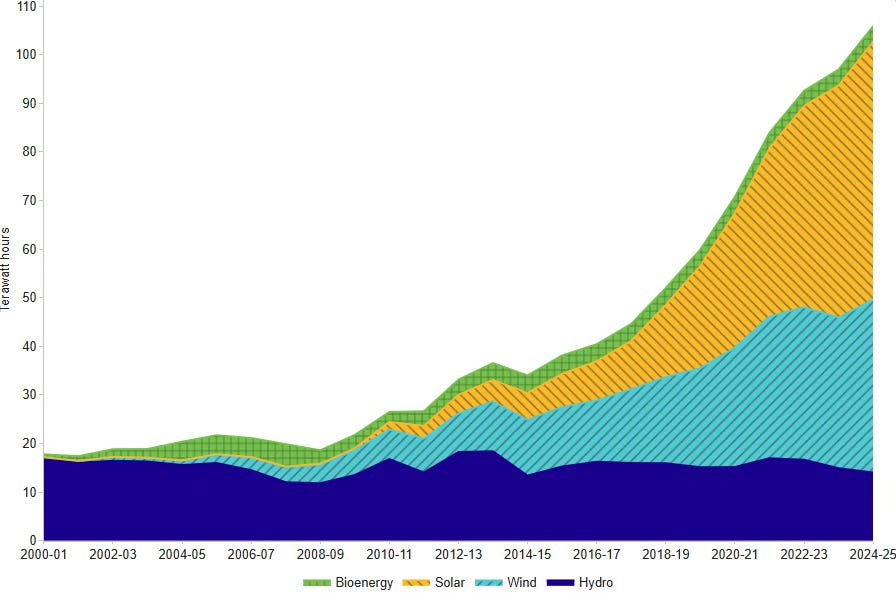
Australian panels and batteries are now generating so much power in daylight hours that earlier this month the Government announced6 eligible households in New South Wales, South Australia and Southeast Queensland would get three hours of free power during the middle of the day every day, even if they don’t own solar. That battery installations have also transformed the market, allowing the solar-generated power to lower electricity prices in the early evenings by reducing the need to burn gas.
Uruguay, population 3.5 million, is another less-well-known example of a country that took a strategic decision to wean itself off fossil fuels by shifting to EVs and ramping up renewable generation for electricity, including through solar7.
New Zealand, meanwhile, is a laggard in both EV adoption and the adoption of home solar panels and batteries, and grid-scale solar and batteries.
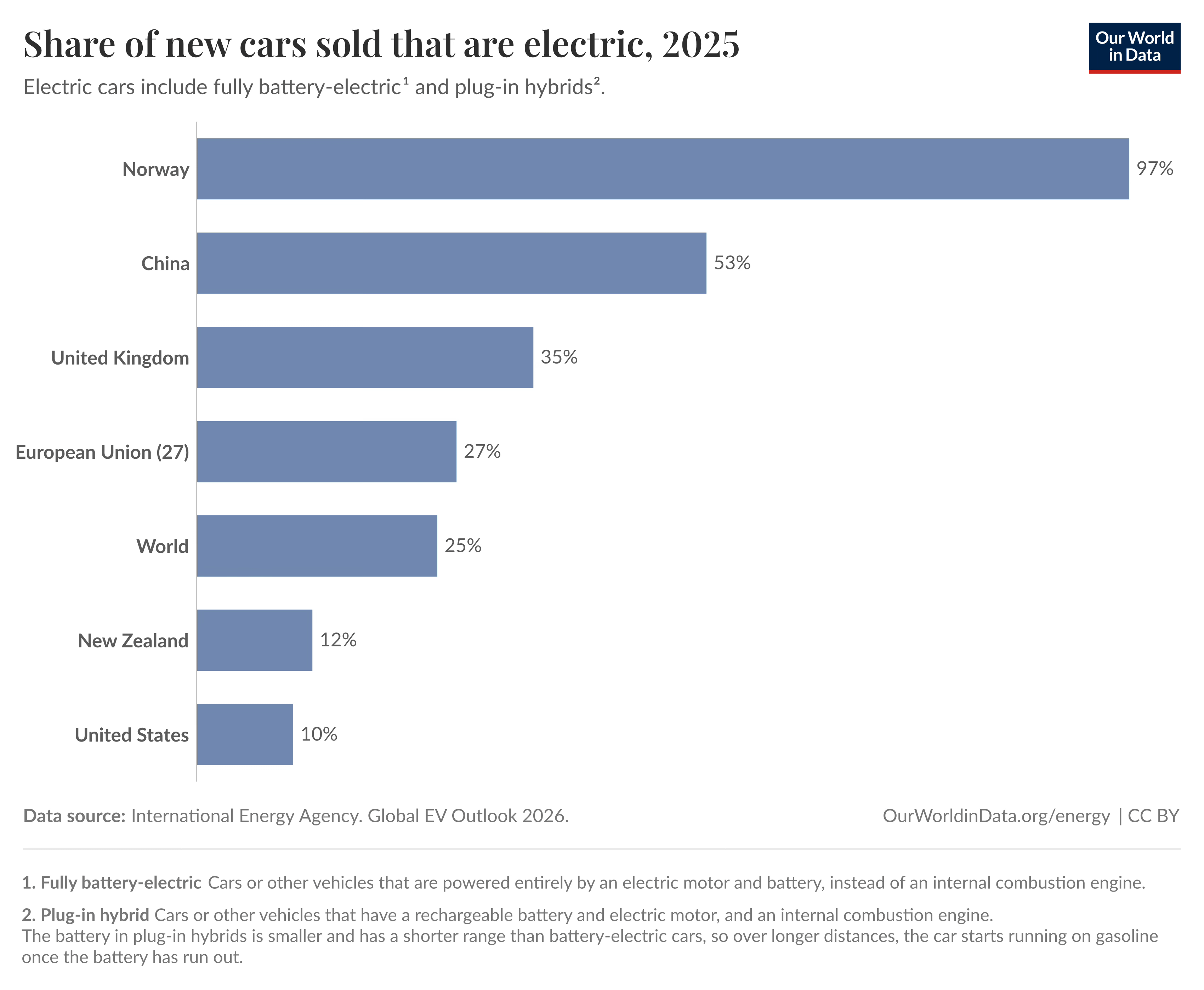
This window of opportunity may start closing
China’s ability to manufacture EVs, panels and batteries at enormous scale and speed has rapidly reduced prices, but has also caused a backlash that has been amplified by the growing strategic and military competition between China, the United States and Europe. The United States has already slapped tariffs and sanctions on imports of Chinese panels and electrical equipment, aiming to boost its own industry and avoid reliance on China’s technology, which the US fears could be weaponised in a conflict.
The European Union is also cracking down on China’s imports. This withdraw of US and European demand for China’s output will create extra downward pressure on costs, at least for a period.
The danger for New Zealand is if either or both the US and European Union pressure New Zealand to also stop importing from China, or there is a conflict in the South China Sea which physically blocks imports.
The beauty of a fast and large surge of electrification in New Zealand is that the panels and batteries are then permanently and repeatedly generating electricity here year after year, regardless of whether new equipment can be imported.
But a slow electrification creates the risk of being locked out of the ability to keep electrifying.
The Best of the Rest
My Top Pick n’ Mix Six
Deep-dive by Mary Argue for RNZ: How will we live as storms get worse? One region’s story
Deep-dive by Emily Simpson for 1News: ‘I can see the appeal of leaving NZ, and I know exactly which way I’ll vote’ ‘In the latest in our State of the Nation series, a 30-something parent and operations manager shares her views about the current direction of Aotearoa.’
Deep-dive by Matthew Theunissen for RNZ: ‘There isn’t anything’: Students face harsh job market
Scoop by Kate Green for RNZ: Patient fell trying to kill cockroaches at Auckland Hospital, fleas hit wards
Column by Max Rashbrooke for The Post-$: The blindness and blame that make NZ a not-so-great country to raise children
Column by Simon Wilson for his Substack Hopetown : Housing, Fonterra, cement: the crisis of predatory delay ‘The tactic that holds back the progress we know we need’
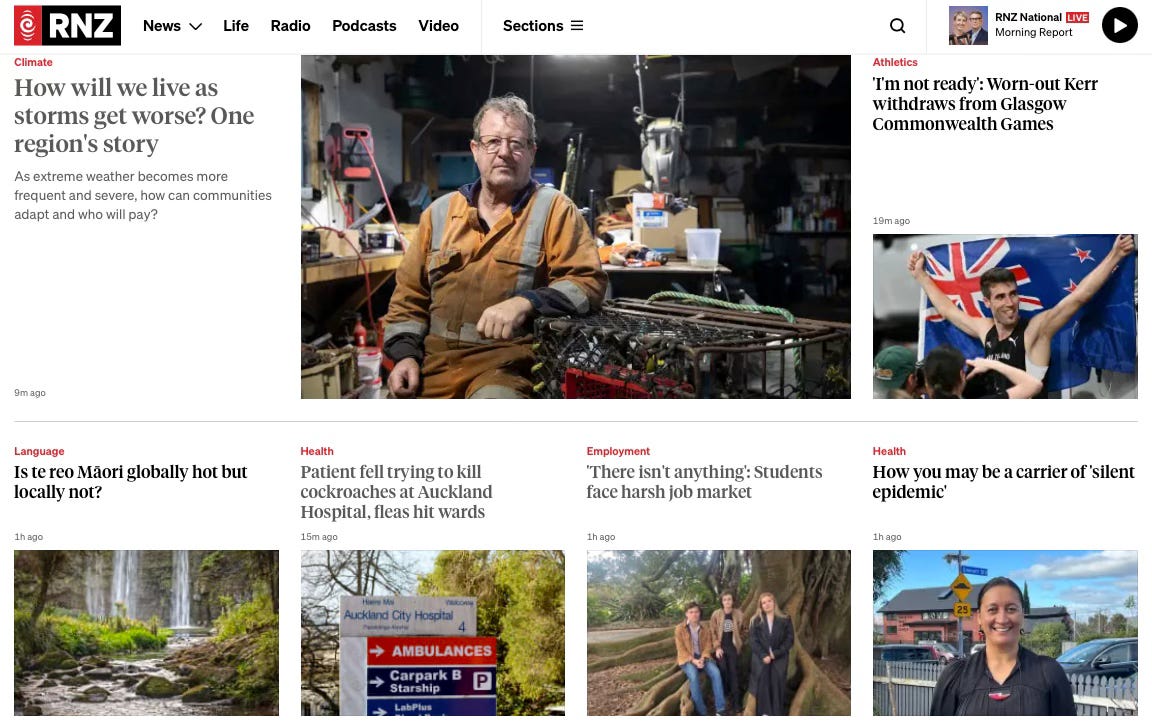
Front page of the Day: RNZ
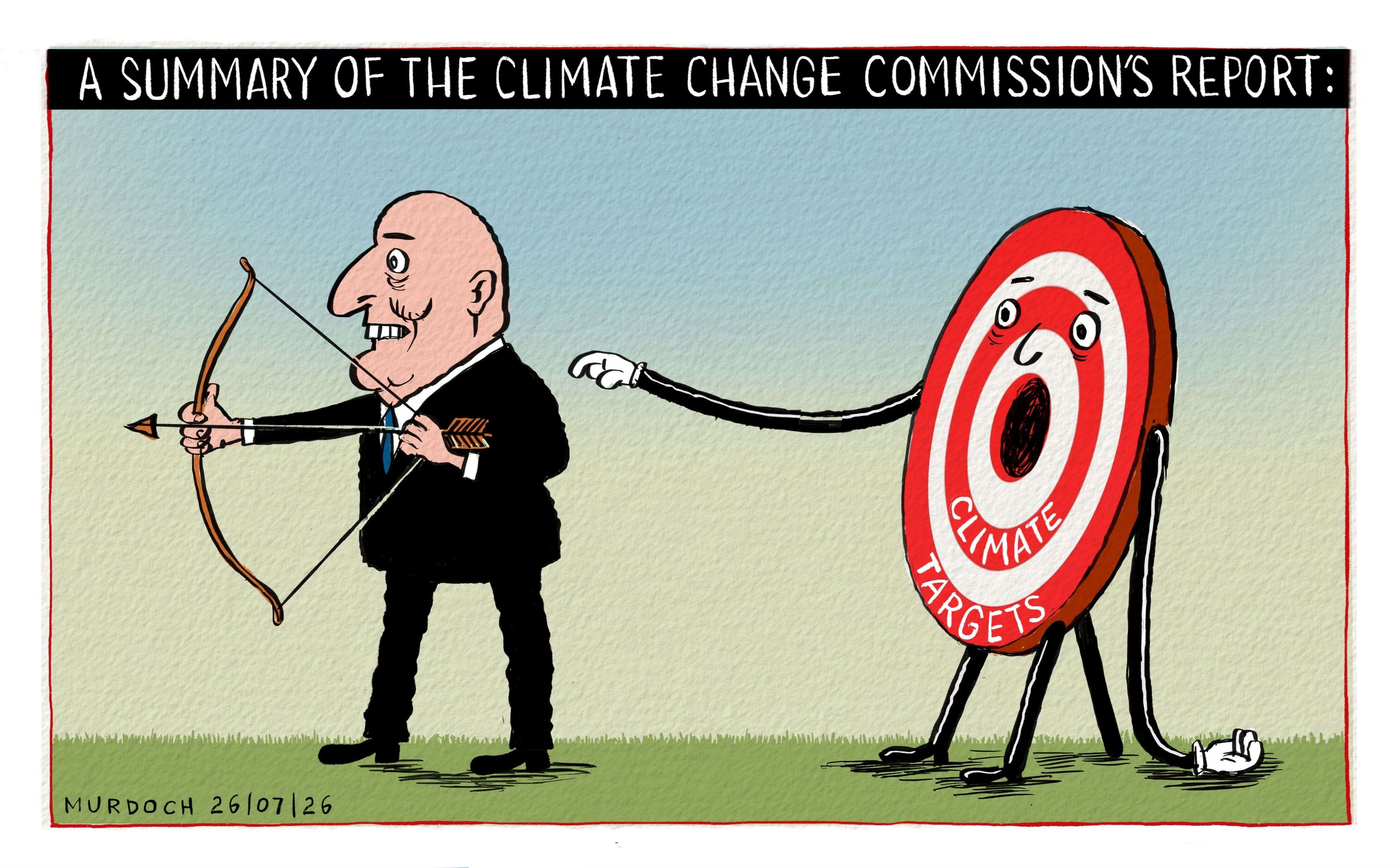
Cartoon of the Day: Ready. Fire. Aim.
Timeline-cleansing nature pic: Morena.

Anything I’ve missed?
cheers
Bernard
PS: I update this post online later in the morning, including more detailed Picks n’ Mixes on housing, climate and poverty, a chart pack and more cartoons. It is only available to paying subscribers, who are also enabled to comment and use The Kākā’s chat room. Check back in here later this morning to see the full lists and chart pack.
Joanne Naish for The Press-$: Christchurch ED doctor says patients regularly treated in corridors, waiting rooms and ambulance bays
Scoop by John Anthony for BusinessDesk-$: Inland Revenue files to liquidate NZ Build Group
Australian Government announcement


