

Mōrena.
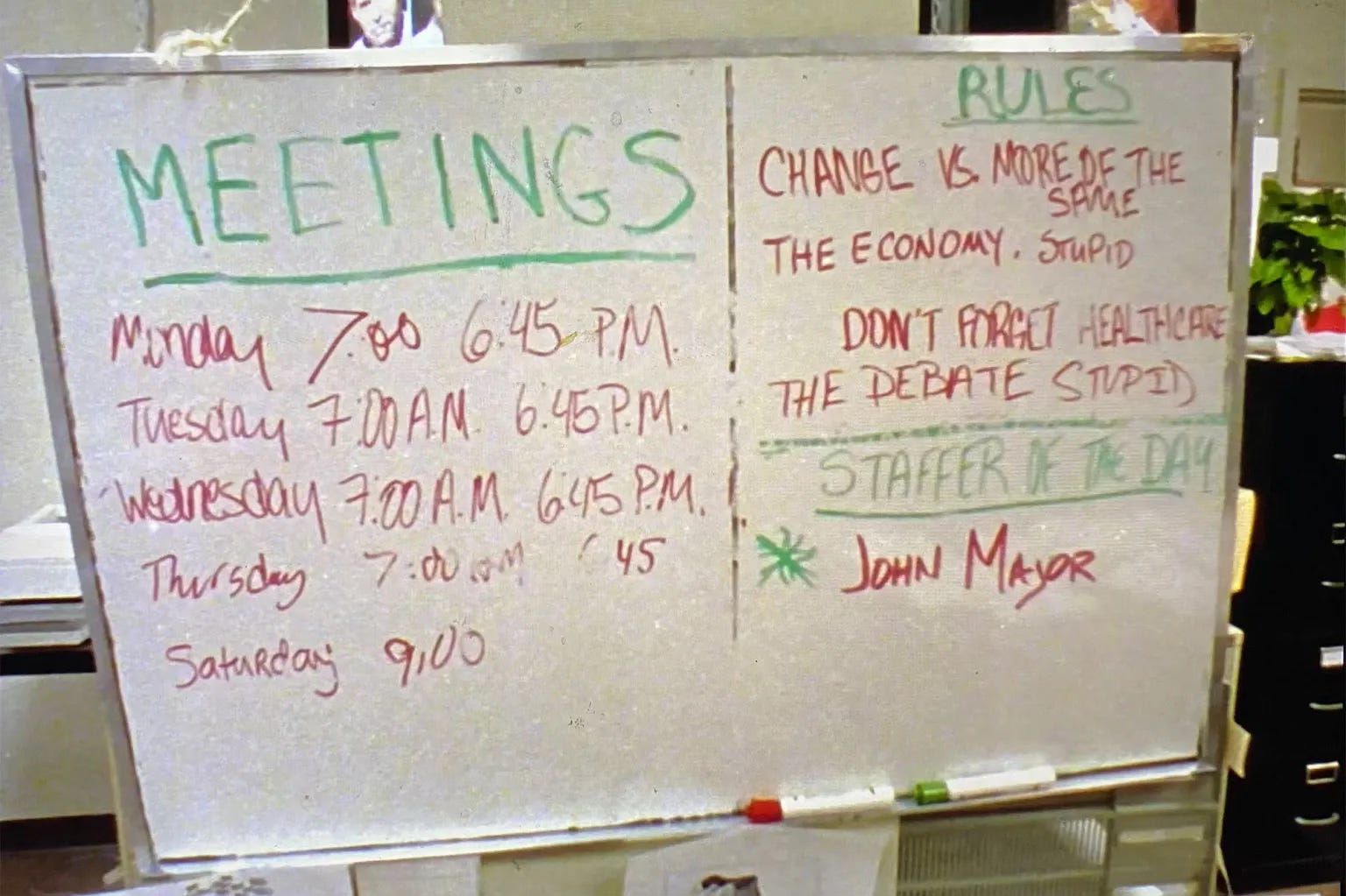
Bill Clinton’s political svengali James ‘the Ragin’ Cajun’ Carville coined the phrase ‘It’s the economy, stupid!’ in the seminal fly-on-the-wall political documentary The War Room about Clinton’s ultimately successful 1992 campaign for the US Presidency.
He wrote the phrase on a white board in the campaign’s HQ in Little Rock, Arkansas to focus campaigners and Clinton in particular on the main thing voters cared about a lot in the immediate wake of the 1990/91 recession. (Interestingly, ‘Don’t Forget Healthcare’ was one of the other things scrawled on the white board.)
The phrase became a byword in modern politics for avoiding the things political operatives and media think are important (scandals, policy contests and political tactics and strategy), and also emphasising the power of personal finances and jobs as a motivating force in politics.
Focus and discipline are precious commodities in any pursuit, but especially in election campaigns in the post-Twitter age, where noise is the default and signal is not.
So far in the last couple of weeks, the main media outlets have focused on the big topics shouted about the loudest by the National-led coalition, at least partly because they have been the loudest, the newest, the most controversial and the most mired in conflict.
Photo appearances by Labour and Green MPs with gang members have been the noisiest issues, along with the panicked shrieks from Finance Minister Nicola Willis about the prospect of Chloe Swarbrick becoming Finance Minister and New Zealand’s apparently parlous public debt situation. Spoiler alert: neither deserve panic.
Then there’s the noise around the ‘horse-race’ of the election polling and tactics. Understandably, there’s a focus on who might ‘win,’ what deals any coalition partners might do and whether split-voting and voter suppression might divert and subvert the will of the people.
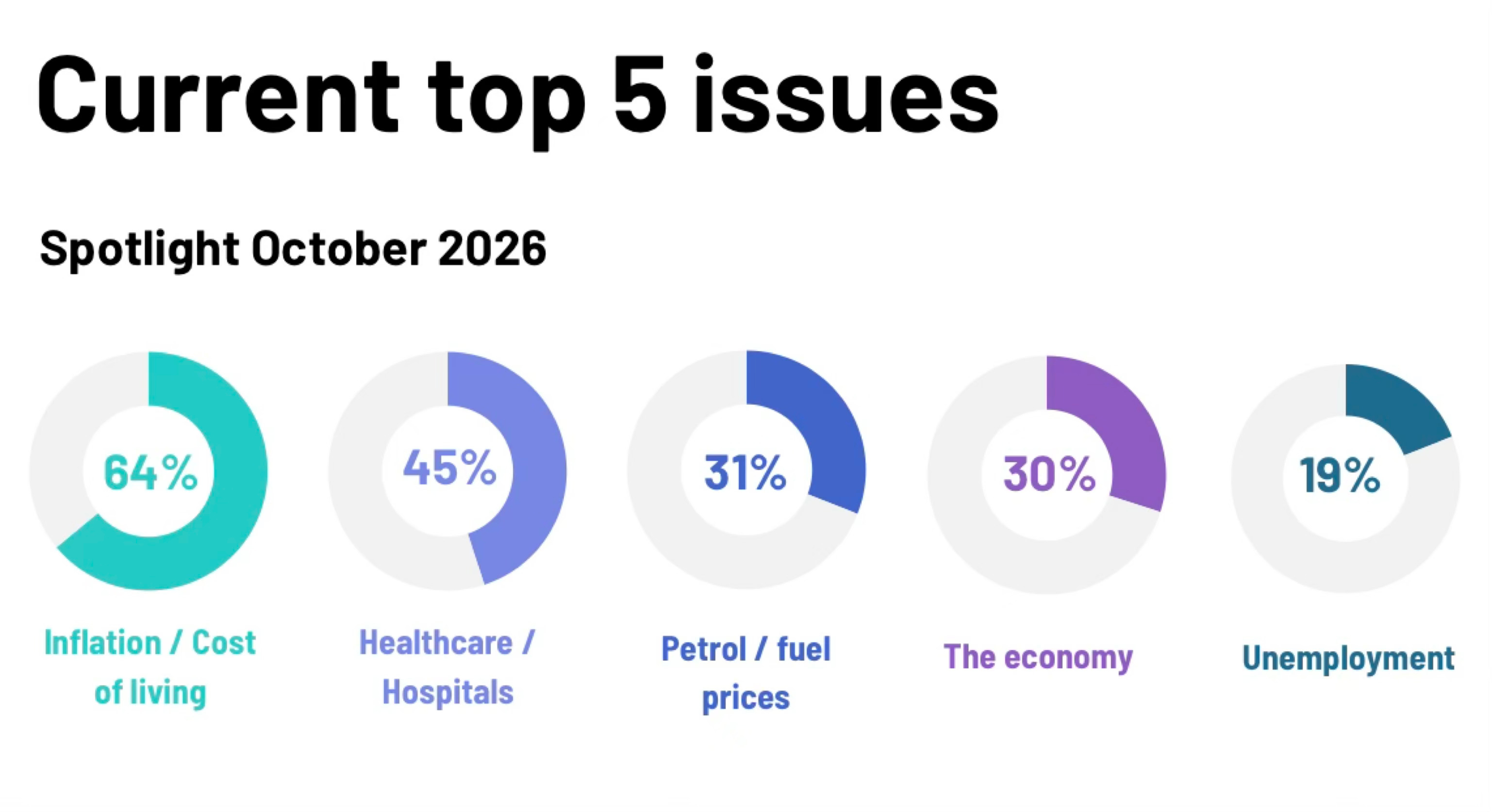
But all the while, the price of fuel has been rising, along with electricity, rates, Government fees and charges and (in some places) rents. Voters have been crystal clear for at least five years that they are most concerned about cost of living, inflation and the cascading crises in our public health and hospital systems.
Perhaps because neither of the major parties are proposing any substantial change to the settings in our political economy, solutions to the ‘cost of living’ and hospital over-crowding crises have not received as much attention.
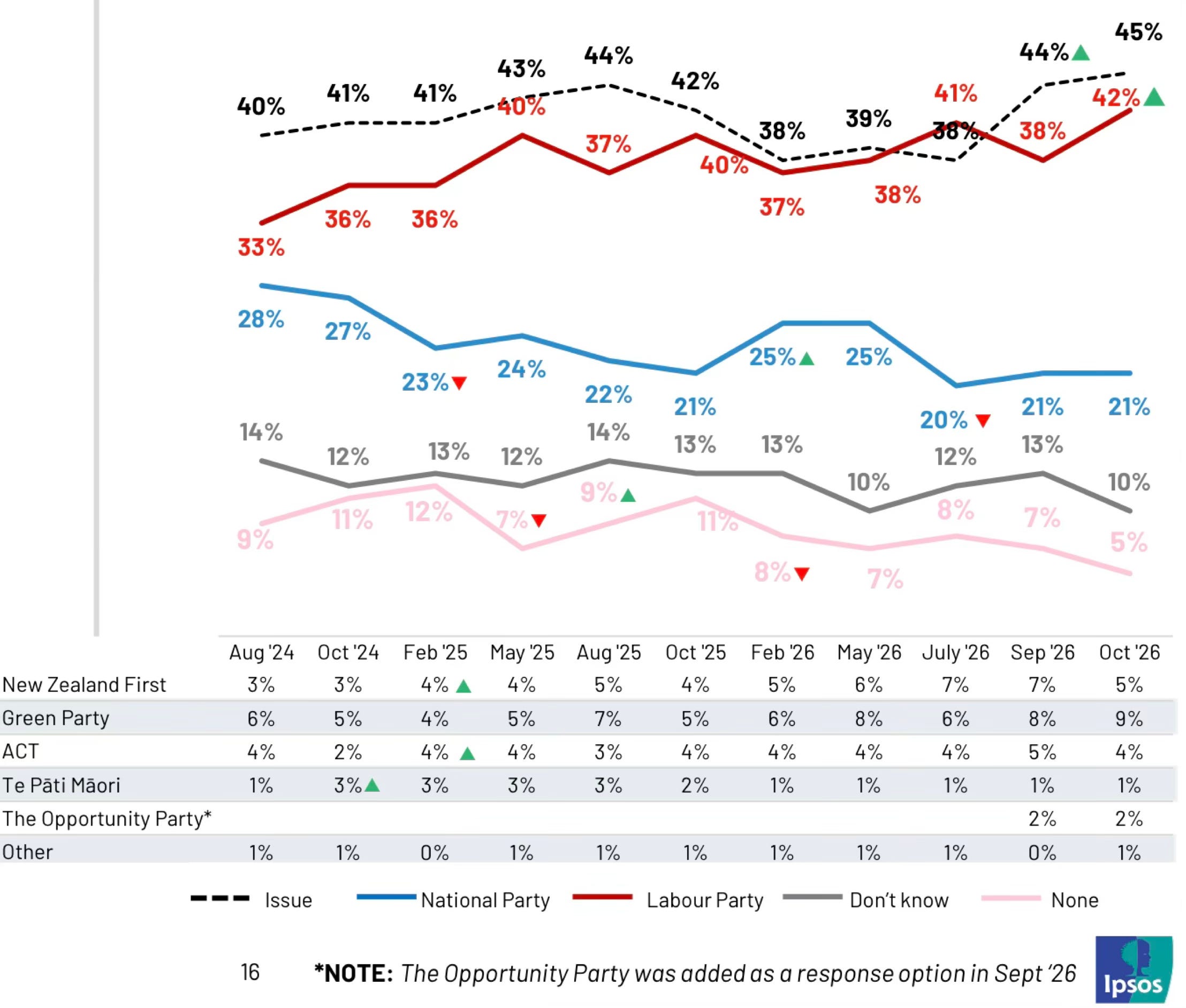
Today’s IpsosNZ Issues Monitor poll, the last before Saturday’s election, should refocus everyone’s attention. It’s also in tune with the ANZ Roy Morgan Consumer Confidence poll results for October, which showed a deterioration in the key ‘time to buy a major household item question.’
Charts of the day: ‘Show us the money’
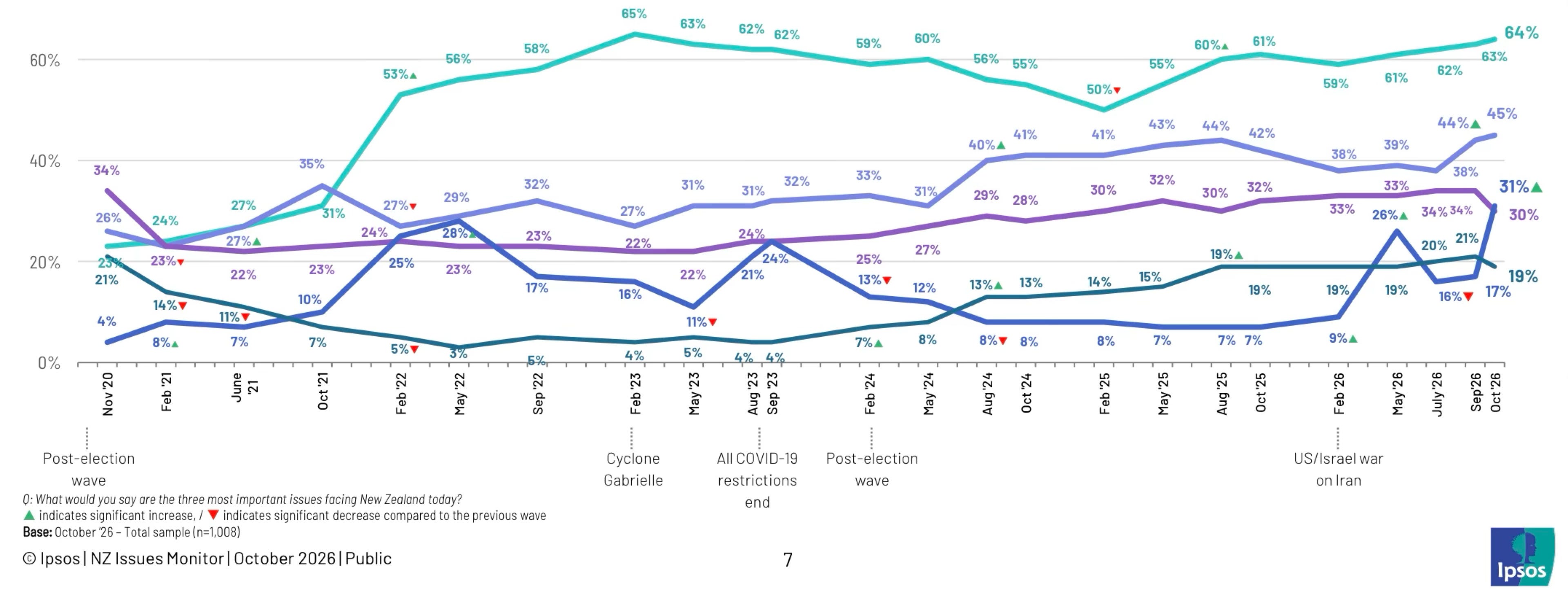
Tax, education & immigration nowhere to be seen
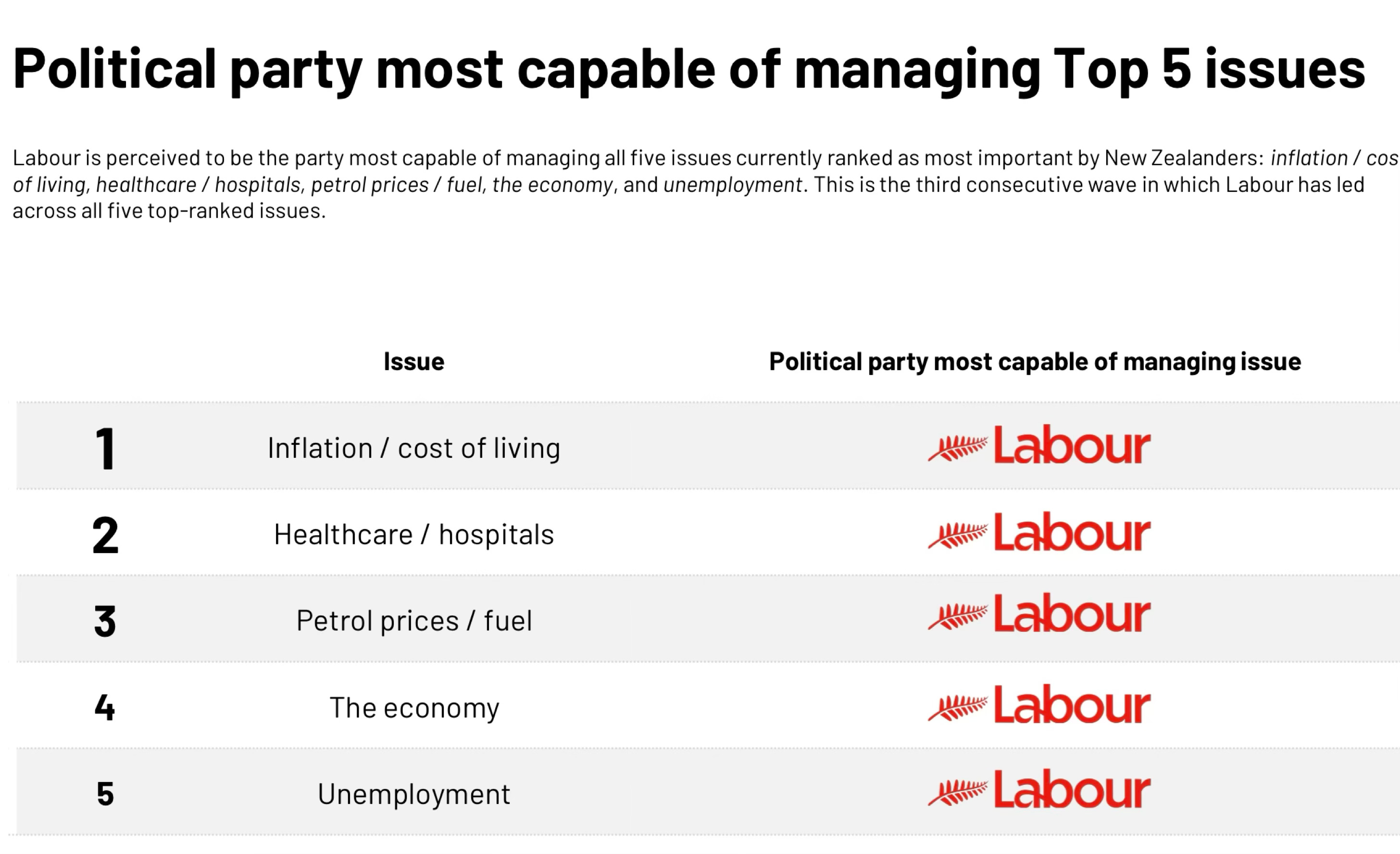
Labour ahead of National on the top 8 issues in top 10
Concern about healthcare & hospitals at record high 45%
Grumpy consumers and citizens
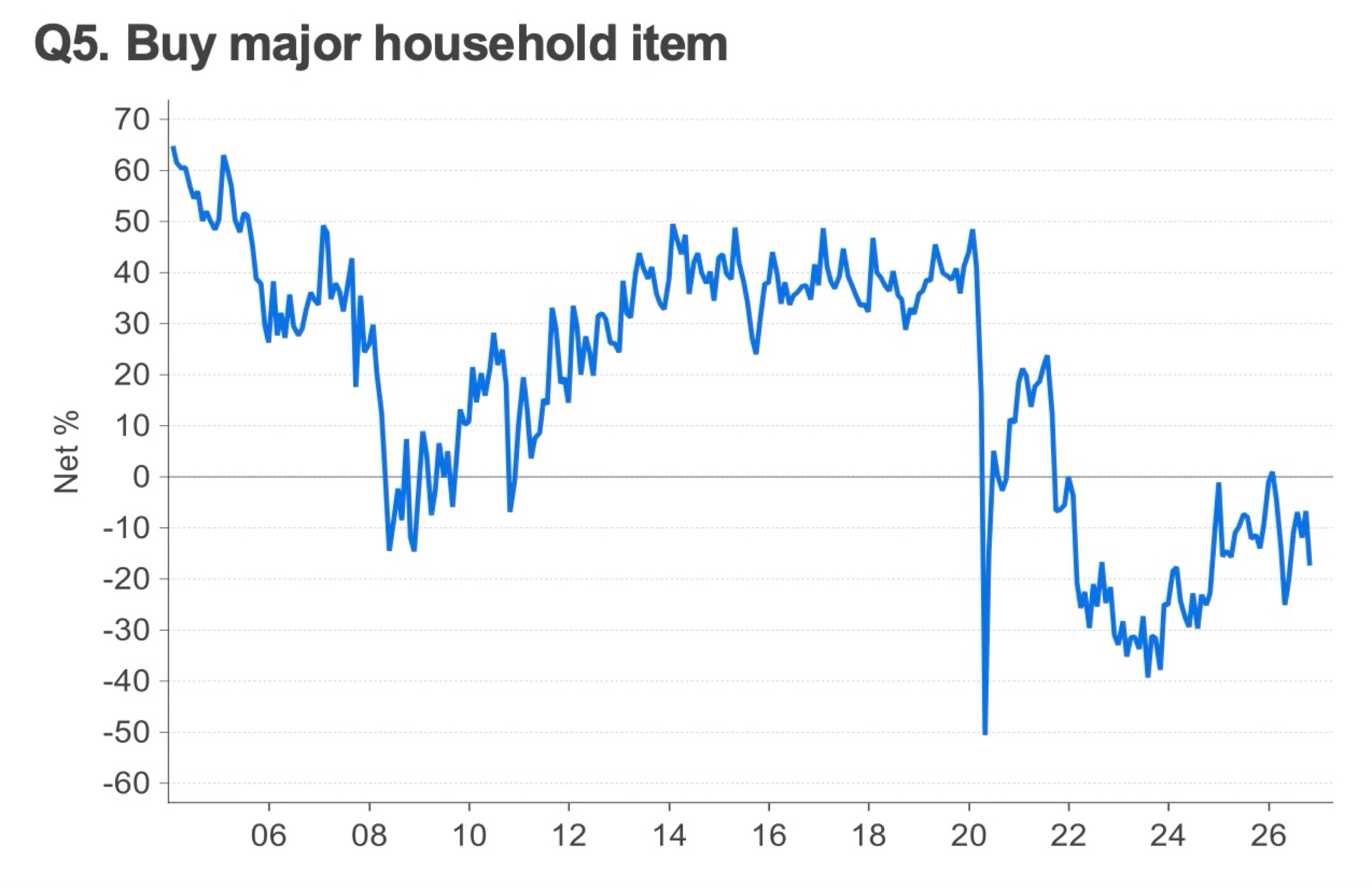
NZ consumers (and voters) are not happy in the last consumer confidence survey before the election. ANZ’s Roy Morgan monthly survey of confidence found a fall overall.
That included:
Perceptions of current personal financial conditions (being better off than a year ago) down to minus 21% from minus 19% in September;
Consumers willing to buy a major household item fell sharply to minus 17% from minus 7%, the worst since May in the initial fallout of the closure of the Strait of Hormuz;
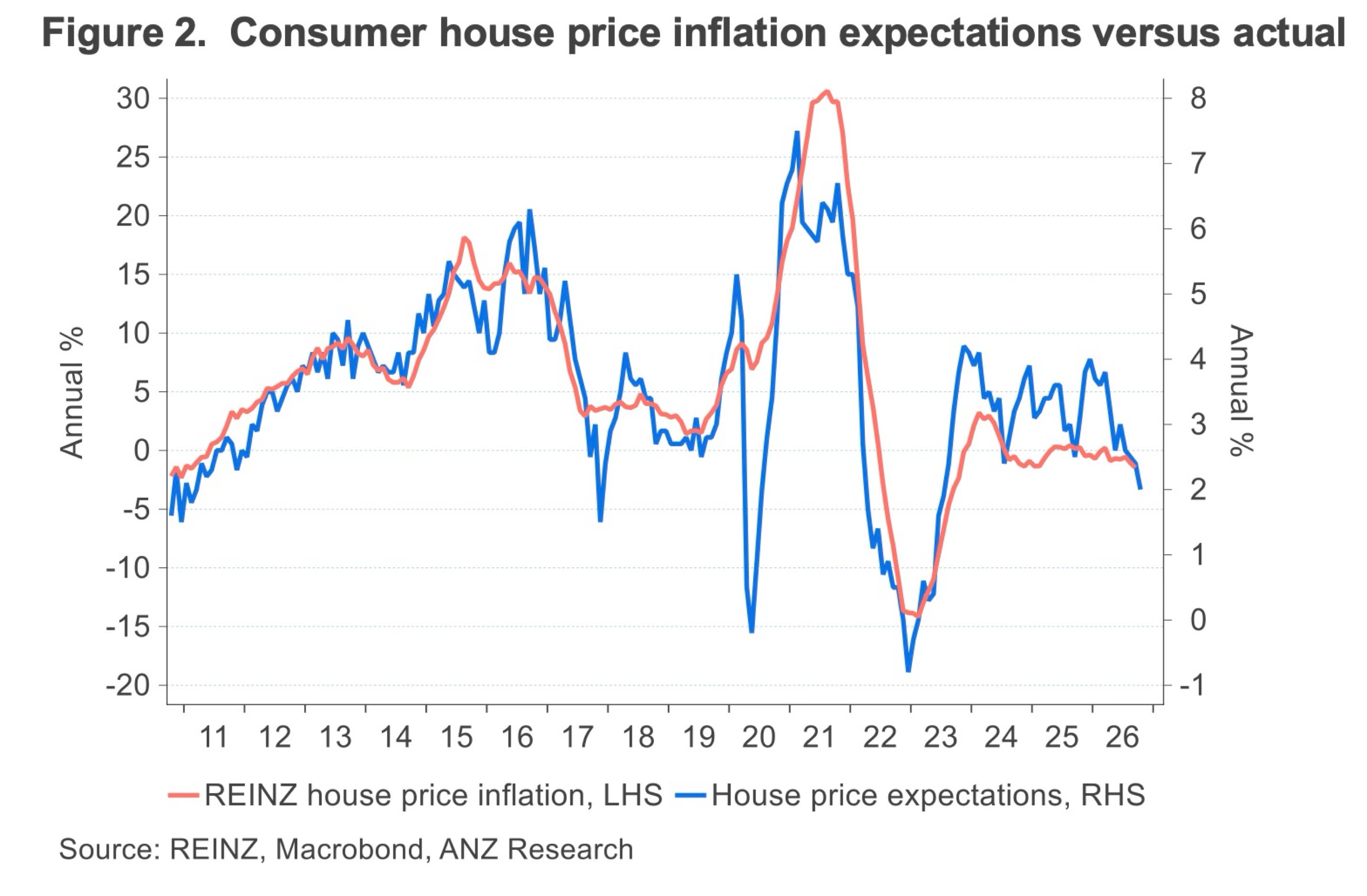
Expectations of average annual house price rises over the next two years of 2%, down from 2.4% in September and the lowest since 2023.
Here’s that house price expectations chart. Also remembering no Government has been re-elected in the MMP era when house prices were falling and real wages were falling.
(I have opened this one up to all immediately because it’s topical. Thanks in advance to our paying subscribers who enable me to do this sort of work covering Aotearoa’s political economy around housing, climate and poverty. Join us as a subscriber if you’d like to see more of this sort of work. Here’s a 50% off introductory offer for new subscribers for the first year.)
My Picks n’ Mixes
Top Six news item of the day
The last IpsosNZ Issues Monitor poll before the election found voters’ concerns about healthcare and hospitals worsened to the poll’s highest-ever level of 46% saying it was one of their top five election issues in October. Concern about cost of living and inflation deteriorated to 64%, its second-worst result ever behind 65% in February 2023. Voter concerns about immigration and education were ranked 10th equal at 8%, with concern about taxation 12th at 6%. Labour was ranked as a better manager of the top eight issues, with National seen as better on crime and law and order (8th), and the Greens on climate (9th).
The Electoral Commission has said it enrolled 93.6% of the eligible population to vote by the early cutoff of October 25, which was 44,568 short of the 3.837 million that would have been enrolled if the enrollment rate had matched the 94.7% achieved in 2023, when enrollment and voting was allowed up to election day, as it had been for decades until the Government changed the rules. In 2023, 110,000 enrolled or updated their details on election day, which is not possible this time. Of the missing 44,568, just over 12,000 are in the 18-24 age group, where the final enrollment rate was 74.2%, which was below the 77% achieved in 2023.
But early voting has been heavier than at the last election, with 143,000 more votes cast in the first five days of voting than in 2023, Electoral Commission data shows.
Health Minister Simeon Brown is withholding or delaying the release of four of the six pieces of official advice provided to the minister since 2024 by the Public Health Advisory Committee, David Williams reports this morning for Newsroom Pro-$ in the Scoop of the Day.
A Climate Action Tracker (CAT) report on New Zealand has found “the list of climate policy rollbacks and reversals is staggering,” with New Zealand’s reversals in the same category as for the United States and Canada. CAT projected in the report on Friday that New Zealand was not on track to achieve its 2030 or 2035 Paris Agreement commitments, which meant it would have to buy overseas emissions credits on a scale larger than any other country relative to its emissions.
Overseas, overnight: Iranian negotiators held a third day of talks with Qatari mediators in the hope of staving off strikes on Iran by US and Israeli forces after US mid-term elections later this week. Oil markets expect a spike over US$120/barrel if Donald Trump unleashes strikes he suggested last week. Meanwhile, the AP and Wall Street Journal published investigations into the damage caused by Iran on US bases in the last rounds of strikes and counter-strikes, including much more damage than previously revealed.
Paying subscribers see more on the items above and other key news in my online-only Picks n’ Mixes and In the Papers Today, and more below.
If you click through to one thing today, make it this…
Robin Martin reported for RNZ over the weekend about how Taranaki Base Hospital’s new Emergency Department, which was opened in late June, is already overwhelmed, forcing nurses and doctors to care for patients in corridors and pushing staff ever closer to burnout:
‘From 1 July to 28 October, the new ED at Taranaki Base Hospital recorded 107 red alerts and 170 amber alerts in 2026, compared with 94 red alerts and 145 amber alerts over the same period in 2025 in the old department. A red alert indicates a greater than 135 percent occupancy rate during the day and 114 percent overnight and signals high operational pressure and triggers internal actions to improve patient flow. An amber alert is triggered at a greater than 108 percent occupancy.
“The (unidentified) ED nurse said staff had been told they would no longer have to care for patients in corridors when they shifted into the new building.
“When we moved in, there was definitely not going to be corridor caring here, but already, you know, we were corridor caring from day one, really.
“We don’t have that many ambulances in Taranaki, so we can’t, or we try not to ramp for too long, but even that, you know, sometimes we’re ramping ambulances when we don’t want to be, because there’s nowhere to offload these patients.”
Ramping refers to continuing to care for incoming patients in ambulances because there is no room for them in the ED.
“I think recently there were more than 40 people in the waiting room because the whole ED was full.”
The ED nurse believed the pressure on the department was taking a toll on staff.
“Everyone’s burning out, you know, the managers are dealing with roster shortages every single day because people are off sick, burnt out.” Nurse quoted in Robin Martin’s report for RNZ: ’Corridor caring from day one’: New ED overwhelmed by patients
Top Six Scoops & Breaking News items of the Day
David Williams for Newsroom Pro-$: ‘Disgrace’ that minister is sitting on public health advice
Isaac Davison for Stuff: Wealthy businessman offered MPs $200,000 to prove climate change is real
Fox Meyer for Newsroom Pro-$: Labour outspends entire coalition Government on Facebook ads
Jill Heron for Newsroom Pro-$: Council refuses to guarantee water safety
Adam Pearse for NZ Herald: Leaked message: National Tāmaki supporters told ‘don’t wear blue’ ahead of Luxon walkabout
Andrea Vance for SST-$: Dirty Politics’ strategist Simon Lusk hired to retail crime advisory group
Top Six Features, Deep-dives & Comment of the Day
Column by Hayden Donnell for The Spinoff: Embarrassing: Impudent youth are carrying out the best journalism of the election
Rachel Pannett for BusinessDesk-$: Solar policies likely to survive coalition talks
Melanie Nelson for her substack: David Seymour’s Mont Pelerin Society membership – and why it matters. ‘His declared membership connects him to the reformers behind Rogernomics and Ruthanasia – and ideas shaping government policy today.’
Mihingarangi Forbes for her substack: Mince on Rice and the Madness of Election Week. A plate of mince on rice, rising child poverty and the final sprint to election day. ‘Meanwhile, interviews with politicians, Police and Oranga Tamariki raise troubling questions about accountability. Justice Moore KC found that, at one point, reviewing the captured footage had fallen up to two weeks behind. In April 2025, footage from a live camera captured images of Phillips and his children. They didn’t view it until five days later. And despite that backlog, emails released under the OIA show police were planning to reduce the size of the investigation team just four months before the children were found.’
Richard Murphy on his substack: Government debt is good for us ‘In any money-based economy when one person saves another must borrow. So, it’s best that the government borrows because if it does not we all have to borrow instead - and that’s much riskier.’
Susan St John on her substack: : Deepening poverty is the fruit of top-end appropriation of wealth. Time to wake up and Should New Zealand Superannuation be just a welfare benefit? Heaven forbid
(I have opened this one up to all immediately because it’s topical. Thanks in advance to our paying subscribers who enable me to do this sort of work covering Aotearoa’s political economy around housing, climate and poverty. Join us as a subscriber if you’d like to see more of this sort of work. Here’s a 50% off introductory offer for new subscribers for the first year.)
Paying subscribers see more on the items above and other key news in my online-only Picks n’ Mixes and In the Papers Today.
Cheers
Bernard


